

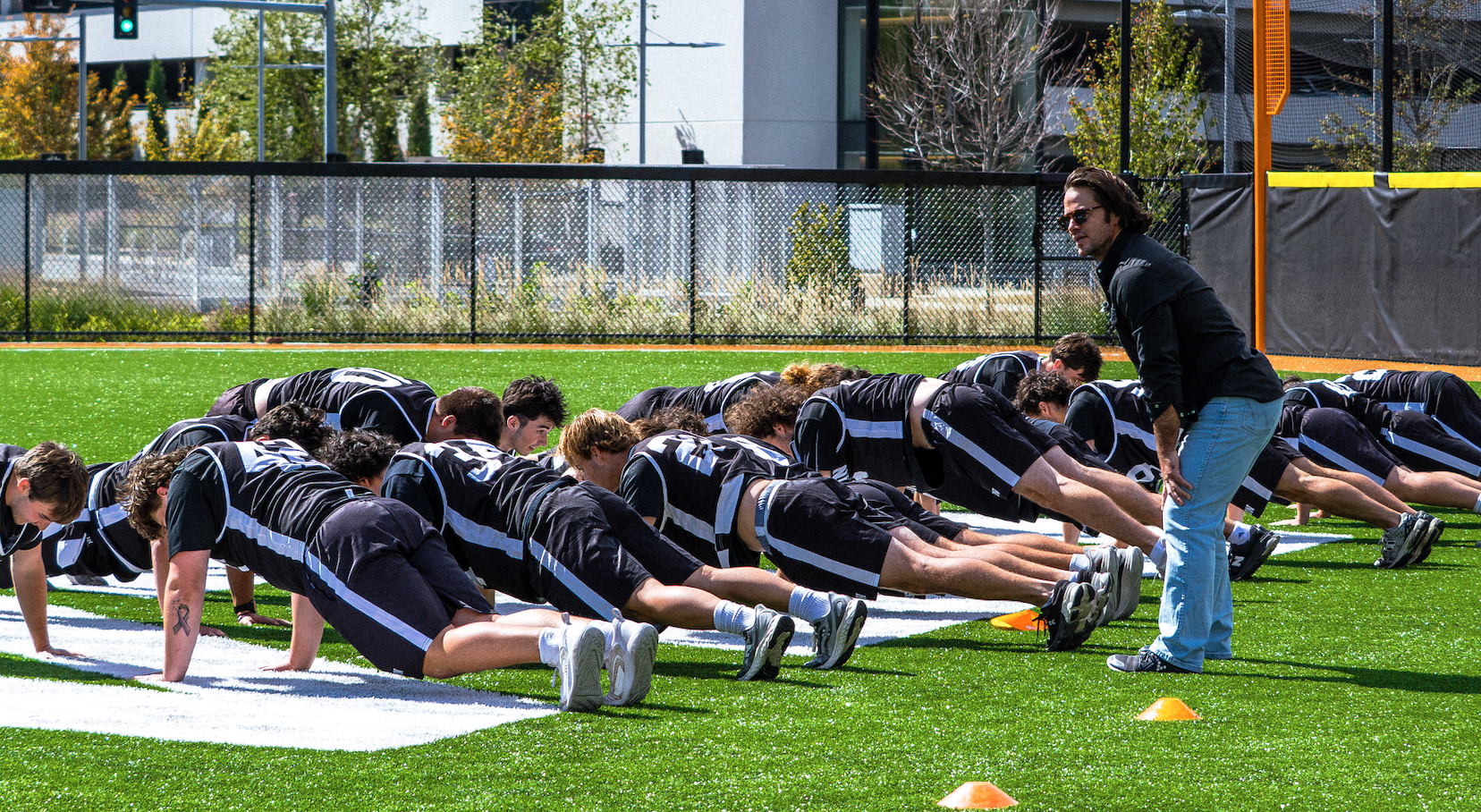


Most coaches talk too much. The best ones cue.
I shared this idea at the Soldiers to Sidelines Sports Performance Seminar. The zoom was full of coaches who care about getting better. We dug into where brain, body, and behavior connect. We covered what to coach, when to coach it, and how to say it so it sticks. And we finished with cue triage, a simple way to decide which correction matters most right now.
Here is the playbook.
There Is No Failure. Only Feedback.
Every coach has watched a drill fall apart. The athlete doesn't get it. The movement looks worse after the correction than before. It's easy to blame the athlete. That's the wrong read.
When an approach fails, it usually breaks down in one of a few places. The movement, skill, or scheme may be too far ahead of the athlete. Trust in the coach may not be there yet. The athlete may be resisting. Or they simply haven't had enough reps and feedback. Openness to coaching sits underneath all of it.
A failed rep is not a verdict. It's information. Our job is to read it and adjust.
A Teaching Framework: Define, Model, Shape, Reinforce
Great coaching isn't random. It follows a sequence. I use four steps.
- Define. Name the movement and its category. Upper body. Lower body. Which planes of motion. Athletes learn faster when they know what bucket a skill lives in.
- Model. Show it. Walk through the set up, the execution, and the common faults. Let them see what right looks like and what wrong looks like.
- Shape. Refine it rep by rep. Start with posture. Move to position. Build toward proficiency.
- Reinforce. Lock it in with well-timed feedback. More on that below.
Skip a step and you pay for it later. Most coaches jump straight to reinforce. They correct a movement the athlete never had defined or modeled for them.
Know Where Your Athlete Is
Before you choose a cue, you need to know what problem you're solving. I break every rep into three questions.
- Alignment. Where to be and when to be there.
- Assignment. Knowing what your job is.
- Technique. How to do your job.
If an athlete is in the wrong spot, a technique cue won't help. Fix alignment first. Then assignment. Then technique.
Next, ask where the athlete sits in their development. The four stages of competence give us a map.
- Unconscious incompetence. Ignorance. They don't know what they don't know.
- Conscious incompetence. Awareness. They see the gap.
- Conscious competence. Learning. They can do it when they think about it.
- Unconscious competence. Mastery. It just happens.
An athlete in stage two needs patience and simple wins. An athlete in stage three needs reps. An athlete in stage four needs you to get out of the way.
Bloom's Taxonomy adds one more lens. Learning climbs from remember, to understand, to apply, to analyze, to evaluate, to create. Most practice lives at the bottom of that ladder. Push your athletes higher. Ask them to compare techniques. Ask them to judge their own reps. Ask them to solve problems you didn't script.
Brain Games: Coaching the Whole Athlete
Every cue lands in a brain. It helps to know which part you're talking to.
- Prefrontal cortex: thinking. Conscious, analytical, judgmental, and slow.
- Midbrain: knowing. Unconscious, image-based, nonjudgmental. This is where muscle memory lives.
- Limbic brain: emotions. Safety first. Then fight, flight, or freeze.
Long technical explanations go straight to the slow, judgmental part of the brain. Great movement happens in the fast, image-driven part. And if an athlete doesn't feel safe, the limbic brain takes over and learning stops.
That's why fun equals focus. An engaged athlete is a safe athlete. A safe athlete is ready to learn.
Attentional focus is where the athlete's mind goes while they perform a skill. Your words shape that focus. Your words drive their thoughts. Their thoughts drive action. Choose your words with that chain in mind.
Cues, Not Conversation
Your primary responsibility on the floor is to capture and keep attention. The best way to direct attention is with cues. Not conversation.
How do you know a cue works? Measure it by accuracy and vividness. Does it point to the right thing? Does it paint a picture the athlete can feel?
A strong cue has three parts.
- Description. Positions, then patterns. Set up the hands and body. Then give one action verb for the execution.
- Direction. Where you want them to go. Toward, away, up, over. Prepositions do the heavy lifting here.
- Distance or duration. How far? How many? How long?
Then bring it to life with imaginative play. Use analogy-based demos. Show some exaggerated personality. Turn obstacles into adventures. Ham it up. Exaggerate the risk of the real obstacle. Let athletes imagine themselves as heroes. A kid who is crossing lava will focus harder than a kid who is stepping over a line.
Timing the 4 R's and Cue Triage
What you say matters. When you say it matters just as much. I time feedback with the 4 R's.
- Rep it out. Set up, set free, repeat. Sometimes the best feedback is another rep.
- Real-time. Instant, stop, correct, hands-on. Use it when the fix can't wait.
- Reference. Call back and call out. Connect this rep to the target.
- Reflection. Evaluate, construct, feel. Let the athlete process the rep.
Cue triage puts those tools in order. When a rep breaks down, don't fix everything. Follow the rule of one. Give one cue at a time. Check alignment and assignment before technique.
Then use reference. What is the target? Then use reflection. How did it feel? What were you aiming for?
One clear cue beats five good ones every time.
Which Hat Are You Wearing?
Every moment of practice asks you to wear a different hat. Teaching. Coaching. Correcting. Connecting. Know which one you have on. An athlete who needs connection won't hear a correction.
Then hold the mirror up. Ask yourself four questions.
- Clarity. Was my cue simple and specific?
- Confidence. Did I deliver it like I believed it?
- Command. Did I own the space and the attention?
- Connection. Did the athlete trust me enough to try it?
The athlete's rep is feedback on your coaching. Read it honestly.
Sports don't teach lessons. Coaches do.
Keep going. Listen to the full session on the Captains & Coaches Podcast. Grab the resources at captainsandcoaches.com/soldiers.