

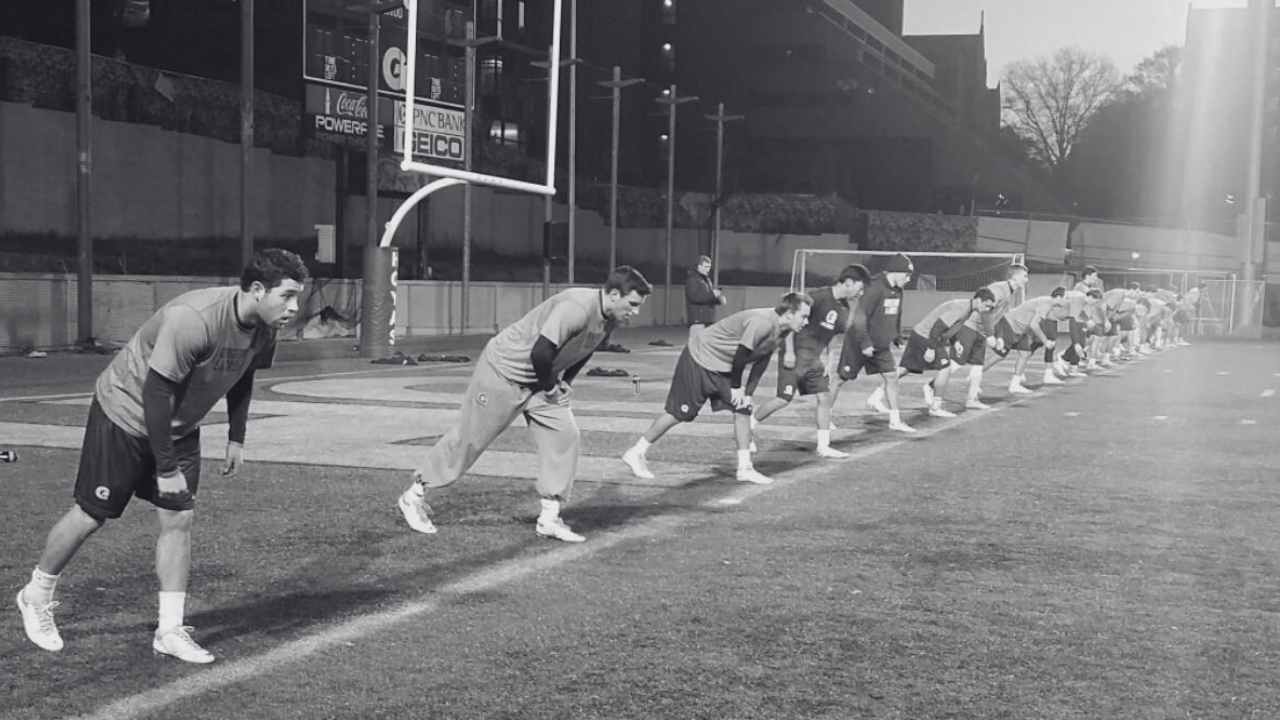


The moment your athletes hear the word "conditioning," something dies. The intent drops. The effort drops. The buy-in disappears before the first whistle blows.
So stop calling it that.
This post breaks down the full presentation I gave at the Soldiers to Sidelines Endurance Coaches Summit: a framework I've built over years of coaching high school lacrosse athletes with no gym, no weight room, just a field, a whistle, and 40 dudes who needed a reason to go hard.
Here's what we're covering:
- Know your audience: who is this kid, really?
- What conditioning actually is (and what it isn't)
- Three purposes that filter every drill and decision
- Real-time application inside a constrained practice window
Let's get into it.
Learning Objective 1: Know Your Audience
Before you program a single rep of conditioning, you need to understand who you're training. Not who you want them to be. Who they actually are.
When I arrived at Marymount as a freshman, I had played lacrosse for about 18 months before committing to college. I picked up a stick at 16. And when I got on campus and saw my teammates play, fear hit fast. I didn't know if I could compete at this level.
So what did I do? I walked into the cross country coach's office and asked to train with the team.
In September of that year, they threw me and my teammate DJ into the NYU Invitational: a Division I, II, and III cross country meet. I finished 238th. DJ, who hated our lacrosse coach so much that he joined cross country out of spite, finished right ahead of me. We competed to not finish last.
That was my first and last cross country meet. I was 185 pounds, squatting 400, and I was a lacrosse player. The cross country coach wanted to turn me and DJ into endurance athletes. It didn't work. At least not for me. And that's the lesson.
You cannot project your bias onto your athletes. Your love for endurance training, hybrid fitness, or functional movement is yours. It may not serve the kid in front of you.
The Three-Filter Framework
When I assess who I'm coaching, I run every athlete through three filters:
Filter 1: Why are they here?Most athletes on your roster (the majority of that bell curve) are there to hang out with their friends. That's not a knock on them. That's reality. A handful are genuinely there to compete and chase the next level. Know the difference, and coach accordingly.
Filter 2: Are they training or just working out?Lifting in a slow, casual environment where there's time to joke around feels very different from conditioning. Conditioning takes away the downtime. It demands focus. If they've only ever "worked out," your conditioning program will feel like punishment. And they'll treat it that way.
Filter 3: Where does their athletic career end?If a kid sees himself as a backup on varsity with no aspirations beyond high school, I'm not going to coach him the same way I coach the kid targeting a D1 scholarship. I'll push both, but the message, the approach, and the purpose have to match.
The Three H's: Getting to Know Them
During rest windows in practice (between sprints, during walk breaks) I ask my guys three questions:
- Hero: Who showed up for you as a kid? Who do you want to be like?
- Hardship: What have you carried? What's been hard?
- Highlight: What are you proud of? What lights you up?
This isn't small talk. It's intelligence gathering. When I know who a kid's hero is, I can reference it when the going gets tough in a 300-meter shuttle. When I understand a teammate's hardship, the guys who have more start treating the guys who have less with more respect. The shared suffering of conditioning becomes a vehicle for actual team cohesion. Not just a fitness test.
Learning Objective 2: What Conditioning Is and Isn't
Let me clear a few things up fast.
Conditioning is not cardio.Conditioning is not punishment.Conditioning is not something you throw at a team because they had a bad practice.
I've gotten the call. Every strength coach has. "Hey, they couldn't get it together today. Run them two miles." Yes, sir. And then you scramble to rebuild the rest of your training plan.
That reactive, punishment-based approach does nothing for performance. Here's the framework I actually use.
Work Capacity vs. Work Efficiency
These two terms get confused constantly. They are not the same thing, and they don't serve the same purpose in your training calendar.
Work Capacity is about building the engine. This is your first two to three weeks of preseason: general physical preparedness, aerobic base, getting them in shape to then get into sport-specific shape. It's a phase, not a permanent state.
Work Efficiency is about repeatability. Can their nervous system call upon strength, power, and speed play after play, under fatigue? This is what wins games. As you move deeper into your preseason and into the season, your conditioning should shift from volume and base-building toward this: decreasing recovery time between maximal efforts.
The Russian hockey example says it better than anything else.
During the Cold War, the Canadian hockey team kept losing to the Russians in the third period. They couldn't figure it out. So they doubled down on VO2 max training. Better aerobic capacity. More time on the bike.
They lost anyway.
When the Iron Curtain lifted and Canadian sports scientists finally got access to the Russian training data, they found that the Russians' VO2 max scores were ten points lower than the Canadians'. But they could still outskate them in the third period.
Why? Because the Russians were practicing at game speed. They trained fast. They didn't have a better engine. They had better efficiency.
Match your training to the demand of the sport.
Learning Objective 3: Three Purposes of Conditioning
Every drill, every rep, every conditioning session I run filters back to one of three purposes. If I can't align a session to one of these, I don't run it. No matter how good the science looks on paper.
Purpose 1: Develop Mental Toughness and Team Camaraderie
This is intentional shared suffering designed to build trust.
I use long runs, but I also use a lot of isometric holds and pillar work. Why? Because instead of athletes running away from me while I watch, they're in earshot. I can observe how they lead under stress.
Do they disappear into their pain cave and go silent? Do they quit when my back is turned? Or are they fighting, staying up, and bringing their teammates up with them?
I'm watching all of it.
If a guy is resting on his knees during a recovery window, I call it out. Not because of some VO2 max argument about oxygen position. Because I want to know: can you control yourself under pressure? If you can't stand up when I tell you to stand up, that's a coachability issue. More conditioning is the prescription.
Purpose 2: Enhance Coachability in Chaos
Can your athletes hear your voice when their heart rate is jacked?
Can they execute a task when their brain is screaming at them to stop?
These are trained skills. And conditioning is the most reliable environment to develop them. It's simple: get off your knees. Stand tall. Rest in the ready. Can they do it?
If they can't control their body in basic conditioning, they won't be able to execute adjustments on the field in the fourth quarter. Use every session as a coachability test.
Purpose 3: Decrease Recovery Time Between Maximal Velocity Efforts
This is the most measurable purpose. The one most coaches either misunderstand or skip entirely.
Conditioning is not about making them tired. It's about making them recover faster so they can go hard again.
Two examples:
Oregon Ducks under Chip Kelly. They ran a play every 14 seconds on average. That offense wasn't just a system. It was a product of being in elite sport-specific shape. They couldn't run as fast in the third quarter as they could in the first. But they were still running as fast as they could. That's work efficiency. And once they were able to maintain it, the speed compounded. It changed college football.
Boxing. You don't win on punches thrown. You win on punches landed. Work capacity versus work efficiency in its purest form. The better conditioned a fighter is, the more windows they can create to land clean combinations and then recover before the next one.
That's your lacrosse player getting off the field, recovering, and getting back on and executing. That's the goal.
Running Fast vs. Sprinting
Before I get into the tools, one distinction that matters:
Sprinting is not running fast. Sprinting is running as fast as you can.
In my conditioning blocks, I program two types of sprint work:
Volume Sprints: Traditional conditioning. Specific distances, timed, with structured rest-to-work ratios. Early preseason I run a 1:4 work-to-rest ratio. As we approach the season, I compress the recovery. Same distances, less rest. We're still trying to hit maximal velocity. We're just training the recovery.
Intensity Sprints: Maximum velocity work. Two to four reps, full rest between each. These are not the place to squeeze in extra volume. They're about quality and speed. I fill the rest windows with pillar holds and skip/sprint patterning drills because sport coaches hate seeing guys just stand there. Not ideal? No. But we're training lacrosse players, not track athletes.
The Reframe That Changed Everything
Here's where the name comes from.
When I was a junior at Marymount, we had a 24-year-old freshman on our team: John Hart. He came back from Iraqi Freedom. Marine. Tatted up. Driving a BMW on military money. A presence.
We were grinding through conditioning one afternoon, and I was doing my best to keep energy up. He turned around, looked at the team, and dropped one line:
"It's not conditioning, boys. It's getting sexy."
And that was it. RIP John Hart, #37, buried at Arlington Cemetery. That line lives in every team I've coached since.
Because it's more than a reframe. It's actually smarter coaching. It connects to an aesthetic goal that some of your athletes care about more than performance metrics. Lean into it. On brutal days (the 300-meter shuttle days) I tell them tarps off. Let them see their progress. Let them see the physique developing in real time. The traps coming in. The conditioning starting to show. You're not grinding for nothing. You're getting somewhere.
Real-Time Application: The Constrained Practice Window
No gym. No weight room. Just a field, a whistle, and a 90-minute practice window.
Here's how I broke it down:
- 15 minutes: Dynamic warm-up
- 60 minutes: Lacrosse skill work and drills
- 10-15 minutes: Conditioning at the end of practice
With that window, here's what I ran:
Partner Tag: Spatial and time constraints. Foot tag. Pool noodles. Fun, reactive, agility-heavy. Heart rate jacks without anyone feeling like they're doing conditioning.
Pursuit Drills: Push-up to sprint, pursuit angles, the rabbit drill. Reactive, competitive, and sport-specific. I learn a ton about my players from these: who reads angles, who reacts, who's going to be a great defender versus an aggressive offensive player.
Chaos Training: Red light/green light with a whistle. Random sprint intervals. Calling formations in the middle of sprints. Borrowed from UTSA Football's summer training. Go find that episode with Coach K if you haven't heard it.
Sample 5-Day Week (No Game)

The Bottom Line
Your job isn't to punish your athletes with conditioning.
Your job is to prepare them to compete.
Know who they are. Know what they need. Frame the work in a way that connects to what matters to them: performance, camaraderie, aesthetics, or all three. And run every drill back to one of the three purposes: mental toughness and camaraderie, coachability in chaos, or decreasing recovery time between maximal efforts.
If it doesn't fit one of those, it doesn't make your team better. Cut it.
Sports don't teach lessons. Coaches do. And one of the most important lessons you can teach is that the hard work has a name. That name is getting sexy.
Check out Soldiers to Sidelines at soldierstwosidelines.org, especially if you've served.
Raise the Game
Enroll now in our new course on confidence and connection, Why They're Not Listening: Coaching the Modern Athlete. If you’re ready to modernize your coaching, deepen your impact, and develop athletes who become leaders—not just performers—this course is your playbook.
Share this blog with a coach who needs it.
Drop me an email if this message hit home.
Your athletes are waiting for a coach who understands their language…
A coach who can connect, communicate, and elevate.
Let’s raise the game—together.