

.jpg)


Every season, coaches across the country announce their captains.
We hand an athlete a 'C,' give them a title, and call it leadership development. Then the season starts. Adversity hits. And that newly-minted captain cracks, avoiding hard conversations, snapping at teammates, or going ghost when the team needs them most.
Here's the truth: we set them up for it.
We assumed leadership instead of developing it. And those are not the same thing.
The Friend Problem
Most teams don't lose because they lack talent.
They lose because of poor communication, zero accountability, and conflict that nobody dealt with until it was too late.
I've watched captains stay silent while a teammate showed up late to film every single week. When the coach finally asked why he hadn't said anything, the captain said, "He's my boy, Coach."
In that moment, the friend won. And the team's standard quietly died while everybody watched.
That's how it works. A leader drops a standard to protect a friendship, resentment builds across the roster, and the locker room fractures from the inside out. Not all at once, slowly, until it's too late to fix it.
There's No Such Thing as a Dragon
Jack Kent wrote a children's book called There's No Such Thing as a Dragon.
A boy wakes up to find a small dragon in his house. His mother keeps telling him it doesn't exist. So everyone ignores it. And the dragon, denied and unacknowledged, grows. And grows. Until it's so big it lifts the entire house off its foundation.
The moment someone finally acknowledges the dragon? It shrinks right back down to small.
That's unmanaged conflict on your team.
Coaches try to eliminate conflict because they think a quiet team is a healthy team. It's not. A quiet team is often just a team where nobody trusts each other enough to say the hard thing. The dragon is still there. It's just getting bigger in the dark.
Research backs this up: conflict actually strengthens teams when they have the tools to work through it. The enemy isn't conflict. It's the conflict nobody named.
Train your captains to name the dragon before it burns the house down.
The 3 T's: A Framework for the Hard Conversation
Leadership isn't a personality trait you're born with. It's a skill. And like any skill, it requires reps.
On Episode 092 of the Captains & Coaches Podcast, Vinny Malts broke down a practical framework for teaching captains how to have the hard conversation. He calls it the 3 T's:
Timing. When do you say it? Mid-drill, after practice, or one-on-one? Context changes everything. Train your captains to read the moment, not just react to it.
Target. Are you calling out the behavior or the person? A trained leader focuses on the specific action that didn't meet the standard — not their teammate's character. One opens a conversation. The other starts a war.
Tone. You can say the right thing at the right time and still blow it. If your captain sounds like a frustrated jerk, the message doesn't land — it triggers a wall. Tone is the delivery system. A bad one kills the message before it arrives.
Give your captains reps with these three things. Let them fail in practice so they don't fall apart when it counts.
Regression Under Pressure is Data, Not Failure
Even with training, this gets messy.
When stakes are high and athletes are running on empty, captains will regress. They'll yell instead of coach. They'll go quiet instead of lead. They'll snap instead of hold the standard.
Don't write it off as failure. That's game film.
Regression under pressure tells you exactly where your leader's development broke down. It shows you the specific behavior you need to work on in the next training block. Use it. That's what coaches do.
The Standard Has to Travel Without You
The ultimate goal of leadership development is simple: shift accountability from coach-driven to player-driven.
If you're the only person who owns the standard, the standard dies the moment you leave the room.
But if your players own it? It travels. Into the locker room. Into the film session. Into the bus ride home. Into the next season, with kids you haven't coached yet.
The day a young athlete walks up to you and says, unprompted, "Coach, I handled that wrong today" — that's the moment you know the training is working.
Your team doesn't need another conditioning test.
They need one honest conversation from a captain who knows how to have it.
Don't just hand out titles this season. Build the leaders who can hold the standard when you're not in the room.
Sports don't teach lessons. Coaches do.
Raise the Game
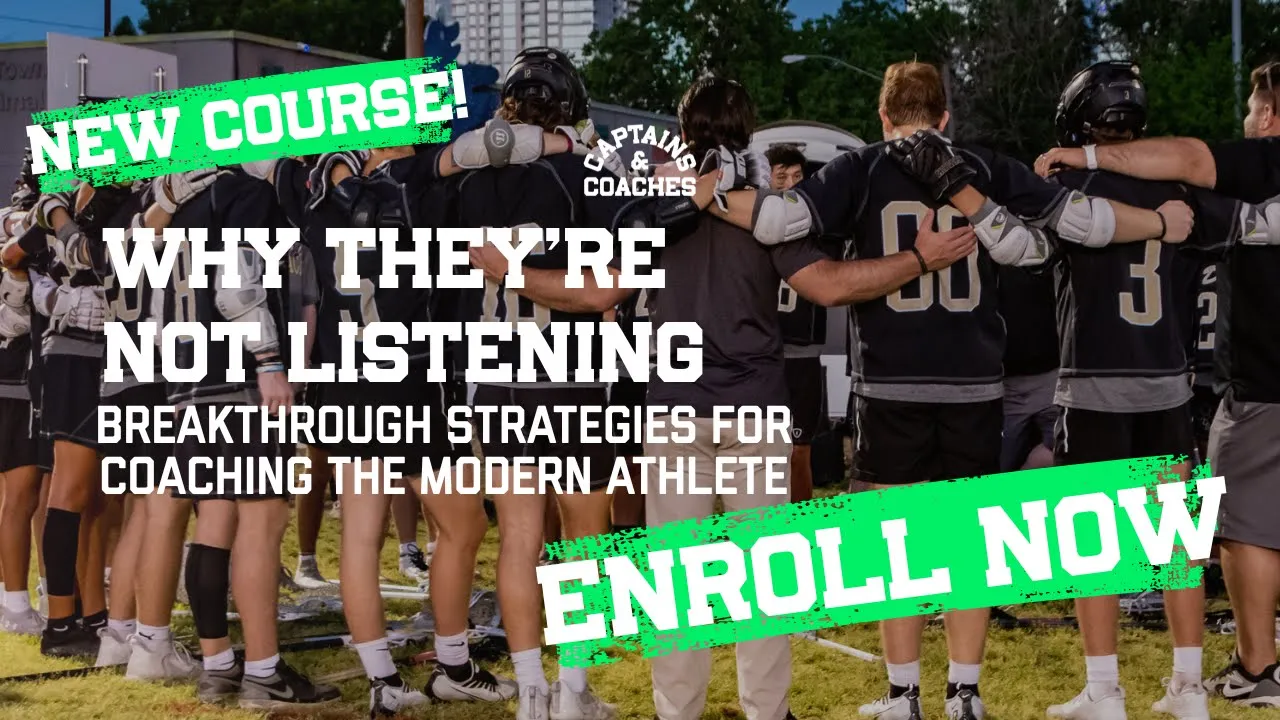
Enroll now in our new course on confidence and connection, Why They're Not Listening: Coaching the Modern Athlete. If you’re ready to modernize your coaching, deepen your impact, and develop athletes who become leaders—not just performers—this course is your playbook.
Share this blog with a coach who needs it.
Drop me an email if this message hit home.
Your athletes are waiting for a coach who understands their language…
A coach who can connect, communicate, and elevate.
Let’s raise the game—together.