

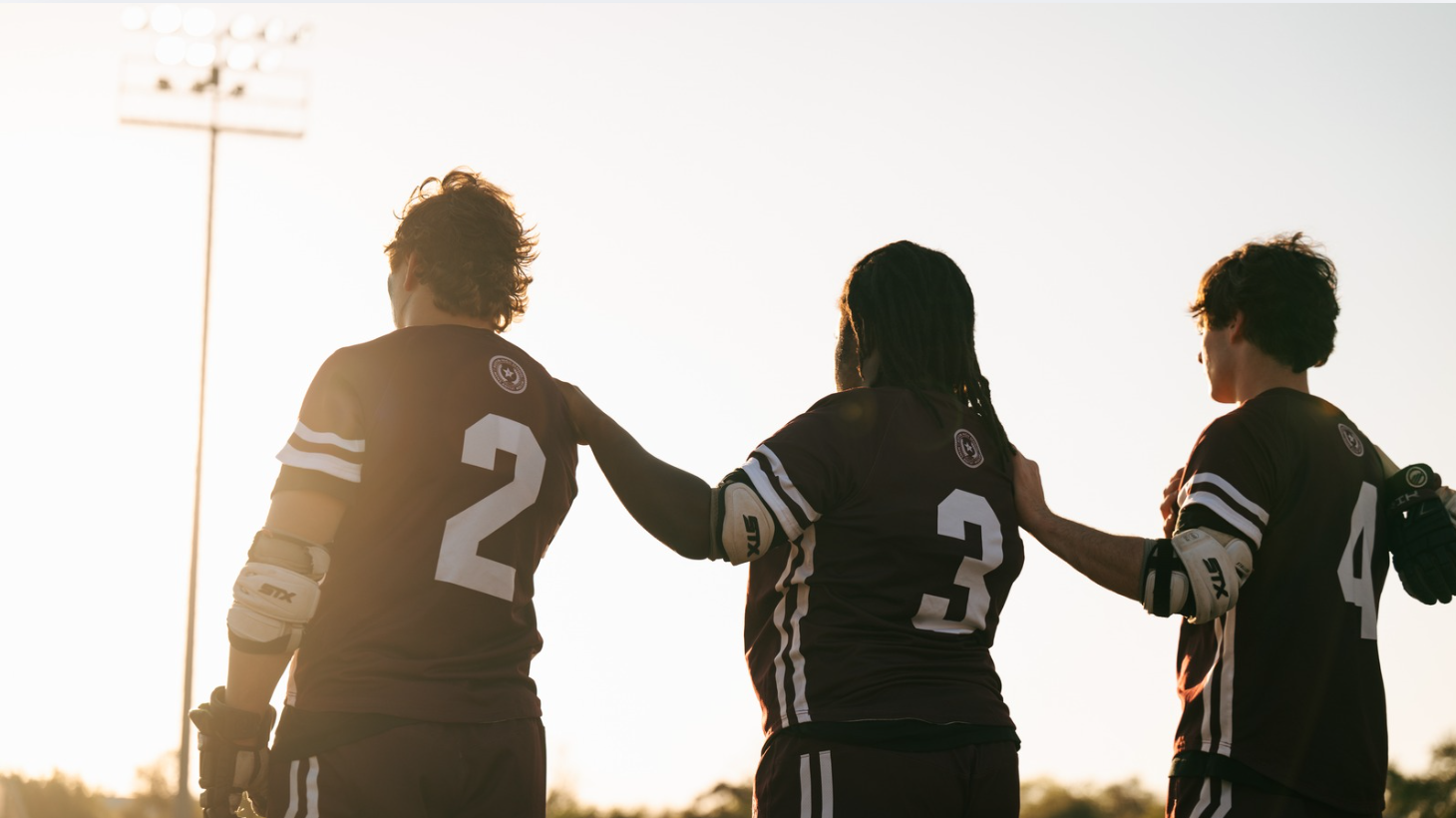


Here's a question worth sitting with: how many reps does it take to actually know someone?
How many sprints? How many film sessions? How many practices before you genuinely understand the person lining up next to you?
For most teams, the honest answer is never.
You can spend an entire season with someone and still not know a single real thing about them. You know what position they play. You know what they do when the game's on the line. You know if they're coachable or if they dog it at practice.
But you don't know their story.
And that's a problem because teams don't bond through reps. They bond through people.
Where This Comes From
The Three H's — Hero, Hardship, Highlight — didn't originate in a classroom or a leadership seminar. It started in locker rooms.
I first learned about this exercise from Ryan Davis, head strength and conditioning coach at the University of Maryland, and we talked about it on Episode 19 of the Captains & Coaches Podcast. Since then, I've used it with coaches, with athletes, and most recently with a group of 14 to 16 year old high school lacrosse players who needed to learn something about grace, empathy, and each other.
Jon Gordon, the author behind The Energy Bus and The Power of a Positive Team, who has worked with some of the most elite teams in the country — has used this exercise in one of its most powerful forms. At Clemson, Dabo Swinney ran a version called the Safe Seat: a player sits in a chair in front of the whole team, shares their Hero, Hardship, and a defining moment, and the room just listens. Jon has described what he's witnessed in that room — guys brought to tears sharing stories about pain and loss they'd been carrying for years, with teammates hearing it for the very first time.
Auburn Golf used it. They won the SEC Championship that year. Their coach said he had never seen a group of golfers more connected.
James Leath, who has facilitated this exercise with dozens of high school and collegiate programs, describes the purpose simply: the activity challenges each athlete to reflect on their life and share three moments that shaped who they are today. The result is always the same — a more connected group.
And it isn't just athletics. Former Royal Marines officers built their entire approach to unit cohesion around this principle. One put it plainly: if you don't know your people, they'll assume you don't care about them. Their perception of your leadership is all that counts.
That's not a soft idea. That's a combat-tested truth.
Why It Actually Works
The Three H's aren't powerful because of the structure. They're powerful because of what the structure forces.
Vulnerability.
And vulnerability changes relationships.
Most team relationships are transactional by default. You know your teammate as a midfielder, a defenseman, the guy who starts, the guy who doesn't. That's it. And when something goes wrong — a mistake, a conflict, a tough loss — you fill in the gaps about that person with your worst assumptions, because you don't actually know them.
The Three H's changes the relationship from transactional to human.
Brian Bowen, head coach of UVA Men's Tennis, understood this the hard way. From 2001 to 2012 — eleven seasons — his team never won a national championship, despite championship-level talent. Then, stranded in a Chicago hotel during a blizzard after another tough loss, he pulled his team together and asked one question: "Do you know each other's families?"
They didn't.
His follow-up: if someone is important to you, shouldn't you know what's important to them?
They spent hours learning about each other's lives. Families sent videos. Guys gave presentations about their teammates. From 2013 on, that team won four of the next five national championships.
Same talent. Different connection.
Jon Gordon distills it as well as anyone: you'll never have commitment without connection. A connected team becomes a committed team.
That's the whole thing. You want your players to run through a wall for each other? You don't get there through practice reps alone. You get there by knowing the person.
The Three H's, Broken Down
Hero
A hero is someone who shaped who you are — dead or alive, someone you know personally or someone you've only read about. A parent, a coach, a mentor, a teammate. The question is simply: who do you look up to, and why?
Here's why this one matters. When you hear someone's hero, you hear their values. You understand what they're trying to become.
If a kid says his hero is his dad who worked two jobs and never complained, you now understand his work ethic and where it comes from. If a kid says his hero is his older brother who struggled with addiction and turned his life around, you understand his resilience and what he carries. You don't just know what they do on the field. You know why they are the way they are.
Hardship
This is the one that takes the most courage — a challenge, a loss, a season of life that was hard, and what it made you.
This is where the walls come down.
When people share vulnerability, it creates what researchers call psychological safety — the sense that this team is a place where it's okay to be human, to struggle, to not have everything together. Teenage boys in particular are conditioned to hide hardship. Toughness is performed. Struggle is hidden. Because the locker room culture often punishes weakness.
The Three H's breaks that pattern. Not by forcing it — but because when one person goes first and shares something real, it gives everyone else permission to be human too.
One important rule: the listeners listen. They don't counsel. They don't fix. They don't try to relate it back to their own story. They thank the person for sharing and move on. Because the goal isn't to solve anything. The goal is to see each other.
If someone gets stuck on this one, the best prompt is: "What's something in your life that, if it hadn't happened, you'd be a very different person?"
Highlight
The highlight is a moment of pride — a peak experience, a personal achievement, something that still makes you smile when you think about it. It could be athletic. It might have nothing to do with sport at all.
And that's the point.
When a player shares a highlight that has nothing to do with lacrosse or basketball or football — when they talk about the summer job they're proud of, the moment they stepped up for their family, the thing they built outside of sport — you see the whole person. Not just the athlete.
Connection between whole people is what holds a team together when things get hard.
My Three H's
I told my team I wasn't going to ask them to go anywhere I hadn't been. So I went first.
My Hero: Coach Michael Cavanaugh. Katy Taylor Lacrosse.
Coach Cav was the head coach of our high school lacrosse team. He didn't have to be there. He showed up for a group of kids who needed someone to show up — and he became the kind of coach you carry with you long after the season ends.
He's the reason I coach. He's the reason I believe sports don't teach lessons — coaches do. Every day I step on a field, I'm trying to be a version of what he was for me.
My Hardship: Losing Drew.
Drew LaFleur was my neighbor, my friend, my teammate. We played lacrosse together in Katy, Texas. We started the program there — a group of football rejects tired of being treated like we didn't matter, so we started something of our own. Drew followed me to Marymount University. My teammate again. And when I became a graduate assistant coach, he was one of my first athletes.
Drew passed away in September.
I've spent a lot of time this year figuring out how to carry that. The answer I keep coming back to is this: Drew taught me that time with the people you love is not guaranteed. The best thing you can do with the time you have is be present for it. Fully there. Not going through the motions.
There.
My Highlight: The Morning in Katy.
This past fall I went home to Houston for my birthday. Saturday morning I made a pit stop.
Drew's sons (nine, seven, and five years old) were playing lacrosse. In the youth program. In Katy. The team we started in 2002.
I stood on the sideline and couldn't say anything for a few minutes.
Because in 2002, we were just a group of football rejects who thought more of ourselves than our coaches did. We started something from nothing. And now, nearly 25 years later, there are dozens of kids in that league — hundreds through the program over the years. Sons of the founders, playing the game.
That's not a record. That's not a championship.
That's a legacy.
And that morning on the sideline, that was my highlight.

What It's Really About
After we finished the exercise with my JV team, I told them something I meant.
The relationships you're building right now are special. You don't know it yet because you're in the middle of it. It feels like just another season, just another practice, just another game.
But look back someday and you'll realize — these were the people. This was the time.
The records? Nobody remembers the record after ten years. The fights and drama that feel so big right now? Those stories only get more exaggerated every time someone tells them.
But the bonds last.
The teammates who were there when something hard happened. The ones who showed up. The ones who knew your Hero, your Hardship, your Highlight — and showed up anyway.
Give yourself a chance to be friends.
You never know how much time you have left with each other.
So you might as well make it count.
You might as well create something special.
How to Run It
A few practical notes if you want to bring the Three H's to your team:
Pick 2–3 players per session to share — after practice, before a film session, whenever you have 15 minutes. Don't do the whole team at once. James Leath recommends capping live groups at 12 before splitting into smaller circles. Spread it over several weeks.
The leader goes first. Every time. This is non-negotiable. If you fake your vulnerability, they'll know. If you go real, they'll follow. Set the tone with the depth and honesty you're hoping to see.
Set ground rules before you start. The role of the listeners is to listen — not to counsel, fix, or respond. What's shared in the room stays in the room. Remind the group that this isn't a competition for the best story. Every share matters.
And if someone gets stuck: "What's something in your life that, if it hadn't happened, you'd be a very different person?"
That question usually does the work.